The BRIGHT Foundation (www.brightfoundation.org), a leader in cure-focused research and family empowerment for chronic brain injury, is proud to announce cooperation with SENIA (Special Education Network & Inclusion Association).
SENIA is a respected global professional network dedicated to advocating for inclusive educational practices. This collaboration marks a significant step toward expanding outreach, sharing expertise, and driving positive, long-term change for individuals and families affected by brain injury and neurodiversity.
BRIGHT’s mission to transform outcomes for those living with acquired or traumatic brain injury—including cerebral palsy, stroke, TBI, and spinal cord injury—aligns closely with SENIA’s commitment to championing inclusion, advocacy, and empowerment across educational settings. The partnership enables both organizations to leverage their strengths: BRIGHT’s research-backed strategies and innovative family support pipelines, and SENIA’s global advocacy, educator training, and community networks.
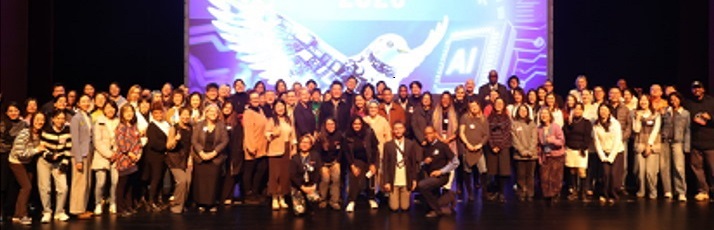
At the most recent SENIA conference, Matt Palaszynski, Founder of BRIGHT Foundation delivered a featured address that resonated deeply with participants and fit closely with SENIA’s mission to promote best practices in special education, inclusive engagement, and empowerment of students and families. The session highlighted cutting-edge advances in neuroregeneration, neuroplasticity-driven rehabilitation, and caregiver-driven advocacy, sparking lively discussion and positive feedback from attendees.
Together, BRIGHT and SENIA are committed to:
Extending outreach to more families, educators, and professionals worldwide.
Empowering caregivers and teachers with practical resources, peer-led support, and access to the latest research.
Accelerating innovation and best practices to help transform long-term outcomes for children and adults living with brain injury and special needs.
By joining forces, BRIGHT and SENIA will reinforce their missions and optimize their impact on the communities they serve. Their close cooperation stands as a model of nonprofit collaboration, driving forward inclusivity, hope, and real progress for millions. For more information on this partnership, ongoing initiatives, and future events, visit www.brightfoundation.org and SENIA.
Partner with BRIGHT Foundation
BRIGHT invites interested organizations to collaborate with us. For more information, please reach out via the contact details listed at the end of this document.
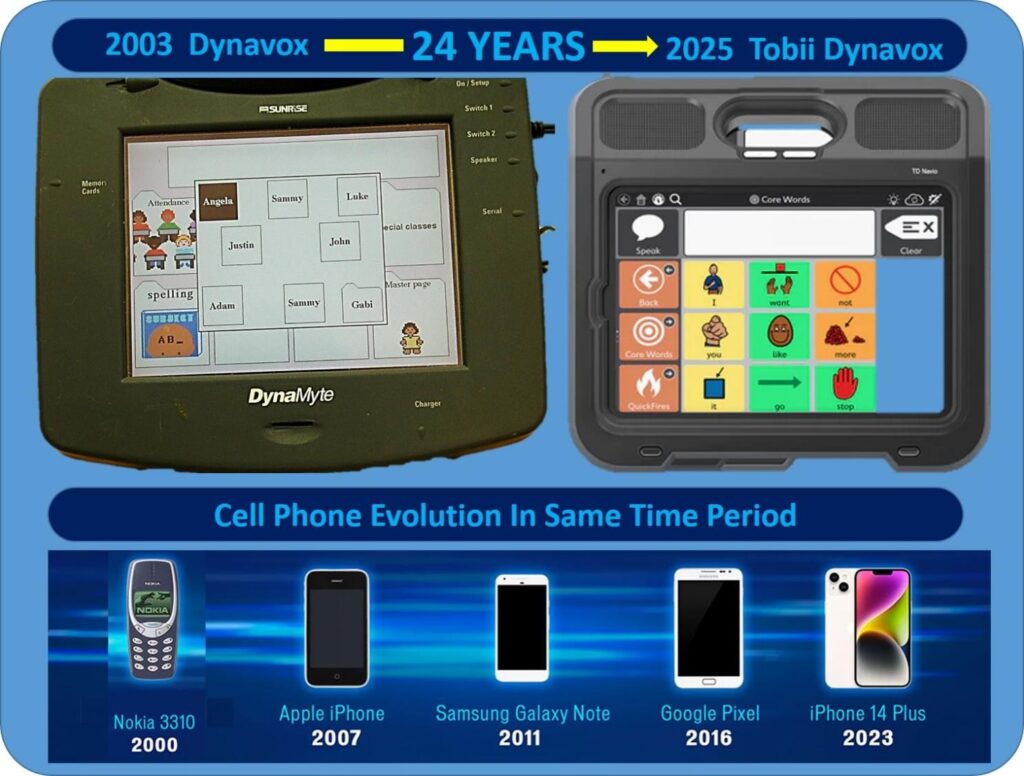
Alissa got her first Dynavox about the year 2003. I remember it being heavy to carry around, not particularly intuitive to use, and very expensive. Fast forward to 2025- from the image below and from personal experience, the situation has not dramatically improved. Contrast that to the improvements in cell phone technology in the same time period and the difference is striking. This article will provide a reality check between the hype vs. lived experience of AAC devices.
This article will explore some of the reasons behind the slower improvements in AAC devices and also explore the “overly optimistic hype” that is often experienced when working with teachers or therapists with regard to AAC devices.
24 years of Dynavox evolution 2003-2025
Scope of this article:
First off, this article is focused on the typical BRIGHT member- individuals with significant motor and/or cognitive challenges. For select individuals who have limited but fine motor control and are highly motivated, an ACC can be a game changer (an example might be someone like Stephen Hawking who lost his speech at age 43, retained his intelligence, and still had fine motor control in one finger). But for many who were brain injured at birth and have global deficits, the experience of using an AAC can be frustrating and underwhelming. Often this results in alternative means of communication such as simple gestures and grunts, being their preferred means of communication. This can be frustrating for professionals who are committed to showing progress in a teaching or therapy setting.
Overview of Augmentative and Alternative Communication (AAC) devices:
An Augmentative and Alternative Communication (AAC) device is a powerful tool designed to support individuals—especially children—who are non-verbal or have significant difficulties with spoken language. These devices provide alternative ways to express thoughts, needs, emotions, and ideas, helping bridge the communication gap between the child and the world around them.
What Is an AAC Device? AAC devices range from simple, low-tech tools like picture boards and communication books to high-tech systems such as tablets or specialized speech-generating devices. At their core, AAC devices are designed to give children a voice when speech is limited or absent. For non-verbal kids, this can be life-changing. Instead of relying solely on gestures or facial expressions, they can use symbols, text, or synthesized speech to communicate clearly and effectively.
Why Are AAC Devices Important? Communication is essential for learning, social interaction, and emotional development. When a child cannot speak, it can lead to frustration, isolation, and missed opportunities for connection. AAC devices empower these children by giving them a consistent and reliable way to express themselves. This not only enhances their ability to participate in school and social settings but also boosts their confidence and independence.
How Do They Work? High-tech AAC devices often use touchscreens with customizable interfaces. Children can select images, words, or phrases that the device then speaks aloud. Some systems adapt to the child’s cognitive and motor abilities, offering eye-tracking or switch-access options. The goal is to make communication as intuitive and accessible as possible, tailored to each child’s unique needs.
Who Benefits from AAC? AAC devices are used by children with a wide range of conditions, including autism spectrum disorder, cerebral palsy, Down syndrome, and developmental apraxia of speech. They are not a “last resort” but a proactive solution that can be introduced early to support language development and interaction.
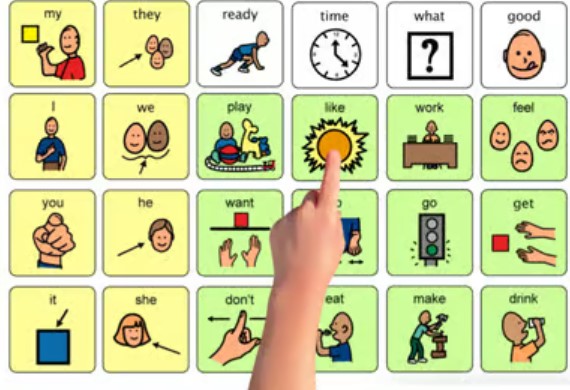
Example of AAC core words screen
Professional Hype vs User/Parent view of AAC devices:
Every year or so we try to take Alissa to a new speech pathologist just to get a fresh perspective and see if there is anything new in the field. Almost like clockwork, and often with a slightly patronizing tone, we are asked “why is she not using an AAC device”? Our halting reply is “Alissa chooses not to use an AAC”. Then in the course of the next 30 minutes Alissa proceeds to flirt with the handsome therapist, express her grief over her recently deceased grandfather, and show her excitement of the idea of eventually fleeing her nest for an independent life. All of that is done with very limited sign language, simple gestures and facial expressions. As her parents, we understand all of it instantly. The therapist, who is used to this type of interaction, picks on 80% even without our help. With our help, Alissa expresses very complex thoughts and has grown dependent on us being there as her AAC device. That’s not idea for Alissa or for us, but it is the Alissa’s fastest and most effective means of communication.
Core Point: AAC Often Fails to Deliver Spontaneous Conversation
I am not saying AAC is useless in every context. I am saying:
It’s too slow for real-time, spontaneous conversation.
It’s too limited in expressive range—especially for poetic, metaphorical, or emotionally nuanced speech.
The marketing around AAC often over-promises and under-delivers, especially when it comes to actual users in unscripted, back-and-forth dialogue.
Many AAC systems are still stuck in a transactional mode: “I want juice,” “I’m tired,” “Bathroom.” That’s not conversation—it’s survival communication.
What does real world use look like?
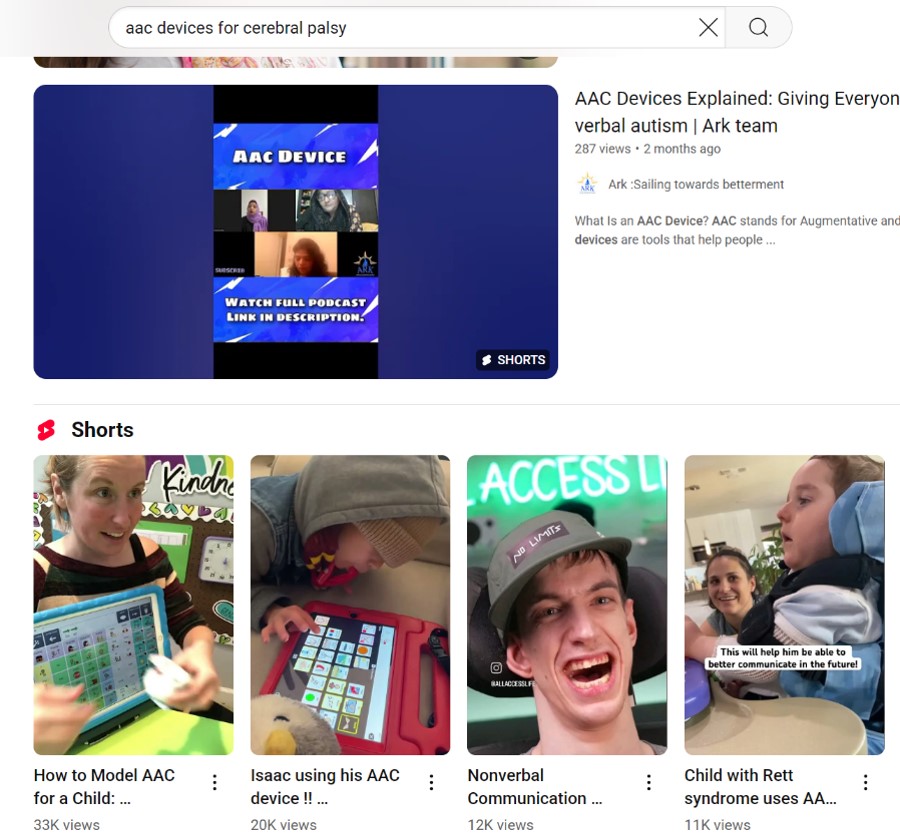
I did a YouTube search of AAC devices and in the Top 100 videos sorted for both “most relevant” and “most recent”. I did not find one single video showing a 5-10 minute unedited clip of an AAC user navigating a real social situation. Even the parent or user uploaded videos were heavily edited and did not show the mistakes, the pauses, the corrections, or emotional nuance—not just “I’m sad,” but “I feel left out because no one invited me.” I did this analysis because I felt, “my family must be doing something wrong with Alissa, this must be our problem”. But this analysis of the top 200 videos on YouTube on AAC’s seems to prove we are in the majority of users.
Recent YouTube AAC videos
Insistence on device usage:
We have experienced push back in the past from professionals who have suggested a form of “tough love” to force the use of an AAC. For example, if they want use the toilet, don’t recognize that request unless they ask for it on the AAC. However, we have to remember that this is our child’s voice, not just another tool for a therapist. Just like we wouldn’t put our child in a wheelchair and then demand they wheel themselves three miles every day or perform tricks with it, we shouldn’t force the AAC device on them. And if they’re verbally stimming or just being “annoying,” we don’t cover their mouths—so we shouldn’t take away their device or ignore them when they use it in unexpected ways.
Getting used to a new communication method takes time. It can be confusing and frustrating for a child whose whole world of expressing needs suddenly shifts. Imagine being told, “Stop using your voice and use this gadget instead—or we’ll pretend we don’t understand you.” How would we feel? When parents respond only to the device, kids learn to dread it. That’s why insisting on device-only communication makes them resist it every single time.
When our child is sick, scared, or overwhelmed, we don’t shove the AAC in their face and say, “Ask for a hug.” They reach for us as they always have. If they’ve had an accident, we help them without making them say “I need new pants” on the screen while they’re crying. If they begin spinning or engaging in any other self-stim, we don’t interrupt the moment and require them to request permission to spin. No one who speaks verbally has to announce every single action, and our kids shouldn’t either.
Keeping our existing bonds intact is crucial. The device should enhance connection, not block it. We have to put ourselves in our child’s shoes—how would we feel if we had to type “I’m hurt” before someone acknowledged our pain? Or request permission for a hug? We need to preserve those natural, nonverbal ways of reaching out alongside the AAC.
And when our child communicates, we celebrate it. If they communicate something with gestures or a glance and we understand, we shouldn’t ignore them and push the device.
At the end of the day, our child’s needs come before any need to show progress in a classroom or gaslight by using a cumbersome device. It’s our decision as parents how and when the device is used. The AAC is our child’s voice first, and it must be treated with respect—including honoring their impulse to point, reach, or otherwise communicate without it. After all, as adults we can often tell when something’s wrong just by looking at someone’s face or posture; children deserve that same intuitive connection.
Where Do We Go From Here?
I am not just critiquing AAC—I am challenging the entire framework of how we define communication for nonverbal individuals. Maybe the goal shouldn’t be to mimic spoken language perfectly. Maybe it’s about creating new modes of expression that embrace slowness, visual metaphor, or collaborative meaning-making.
Recent progress of AAC devices:
Core Vocabulary Systems: Instead of hundreds of icons, users rely on a small set of high-frequency words (like “go,” “want,” “like,” “this”) that can be combined quickly to express complex ideas. These systems are designed for speed and flexibility.
Predictive Text & Word Prediction: Just like your phone keyboard, AAC devices now use algorithms to suggest words and phrases based on context. This drastically reduces the number of selections needed.
Customizable Phrases: Users can store personalized phrases—like compliments, jokes, or poetic expressions—and trigger them instantly. These aren’t generic; they’re tailored to the user’s voice and personality.
Eye-Tracking & Gesture Control: For users with limited mobility, eye-tracking tech allows rapid selection of words or phrases, often faster than typing.
In the future, BRIGHT plans to explore alternative models—like gesture-based systems, wearable tech, or even AI-assisted conversation partners—that might actually meet the bar that Alissa, and others like her, are setting before they embrace an AAC.
Passing on the information for those who need and could use the TalkTablet. The post is outdated, but the information is still valuable! FREE
Don’t Miss Your Chance.
Communication app giveaway
It is Christmas time and we want to do our part to help families that truly need TalkTablet but simply cannot afford it. So we are gifting 50 (Fifty) copies of TalkTabletUS in time for Christmas. So spread the word as fast as possible.
We will accept nominations at admin@gusinc.com until Dec 13th. Thereafter, we will email the TalkTabletUS Redeem codes to the 50 winners. Please include a brief description of the person that needs TalkTablet and how it would benefit them.
Each of the 50 Redeem Codes will expire on January 3rd, 2013. Therefore, if you win a Redeem Code, you have until January 3rd to download/install TalkTablet onto your iPod, iPhone, or iPad.
If you win a Redeem Code but don’t have, or can’t obtain an iPod or iPad before January 3rd, 2013, simply redeem the code through your iTunes account before January 3rd, 2013 and you will be able to install it an iPod/iPad at a later date when you have an iPod/iPad. No worries.
As 2012 draws to a close, let me once again say ‘thank you’ to all of you for supporting TalkTablet and the people that bring it to you. It is an absolute privilege to create great software for people that rely on it for their day to day communication.
Have a VERY Merry Christmas!! YOU deserve it!!
Gordon Harris, President
Gus Communication Devices Inc.
Andrei Tallent sent BRIGHT this description of a foundation he is working with. The foundation is focused on Cortical Vision Impairment. Please take a moment to check out the website and learn more about this very common issue with children who have suffered a brain injury and cerebral palsy.
Cortical visual impairment (CVI) is the leading cause of visual impairment in developed countries today. In fact, it has been suggested that as many as 80% of those with cerebral palsy also have CVI. Though this is true, an appallingly few number of doctors and therapists know much about it. Many children who have CVI go undiagnosed or misdiagnosed as result. Parents are too often told there is nothing they can do to help their child learn to see. The reality is that CVI very often can and does improve, but only with focused and appropriate intervention.
We created our organization, Little Bear Sees, in 2011 in order to raise awareness about CVI among as many people as possible. Our first step was to create a website (www.LittleBearSees.org) which outlines exactly what CVI is and what you can do about it. In addition to our website , we have also created an iPad and iPhone app specifically for children with CVI (Tap-n-See Zoo) and have just released the first book about CVI written for parents by parents (Little Bear Sees: How Children with Cortical Visual Impairment Can Learn to See).
Every time we hear of a child with CVI who went undiagnosed for years, or meet a medical professional who knows nothing about CVI, we feel even more determined to raise awareness about this condition. In our experience, it is often you, the parents or caregivers, who fill the gap and become experts in CVI and advocates for your children. We hope that the information we provide will help you to do this.
Here is a list of famous, sort of famous, and up and coming talent with Cerebral Palsy!
Comedians, Actors, and Actresses – For famous comedians, actors, and actresses living with cerebral palsy or brain injury, the spotlight shines just as brightly—if not brighter—than for anyone else. Rather than letting CP define their limits, these performers transform adversity into art, blending sharp wit, candid storytelling, and unwavering confidence. By keeping their humor grounded in real-life experiences and embracing authenticity on stage and screen, they not only entertain but also challenge audiences to see ability instead of disability.
Cerebral palsy hasn’t stopped Famous Comedians, Actors, and Actresses from shining in the spotlight. RJ Mitte, known for playing Walter White Jr. in Breaking Bad, lives with cerebral palsy and uses his platform to advocate for disability representation. Comedian Josh Blue, winner of Last Comic Standing, incorporates his condition into his stand-up, blending humor with awareness. Actress Geri Jewell broke barriers on The Facts of Life, becoming one of the first disabled performers in a recurring TV role. These artists prove that cerebral palsy is not a limitation—it’s part of a powerful story of resilience and creativity.
Suffered her brain injury when born three months premature due to her mother’s car accident. She was diagnosed with cerebral palsy at eighteen months. After honing her stand-up act, Jewell caught the eye of producers and, in 1980, was cast as Geri Tyler on NBC’s The Facts of Life, becoming the first regularly featured actor with a disability on a prime-time sitcom. Learn more at gerijewell.com
Josh Blue (Comedian & Athlete)
Winner of Last Comic Standing (2006) who incorporates his cerebral palsy into his stand-up routine. He also played for the U.S. Paralympic soccer team in 2004. Josh has Cerebral Palsy, but that doesn’t stop him from poking fun at himself. Learn more at https://www.joshblue.com/media/
Rosie Jones (Actress & Comedian)
Proudly incorporates her cerebral palsy into her work with wit and authenticity. Known for her appearances on The Last Leg, 8 Out of 10 Cats, and QI, Rosie challenges stereotypes through sharp humor and fearless storytelling. She’s the founder of The Rosie Jones Foundation, which supports young people with CP, ensuring no one feels alone or unheard. Her children’s books, including The Amazing Edie Eckhart, feature disabled protagonists, empowering readers with representation and joy. Rosie’s voice is bold, cheeky, and trailblazing!
Alice Kina Diehl (Actor and Advocate)
Born in 1986 with cerebral palsy. She started acting as a teenager. At 16, she received the John Ritter Scholarship for acting. She trained at the Howard Fine Acting Studio in Los Angeles. Alice appeared in Speechless, Special, and 9-1-1. Her role in 9-1-1 marked her first co-star credit. She voiced a character in Disney’s Strange World. Alice champions disability representation in entertainment. She calls herself “an advocate cleverly disguised as an actor.”
RJ Mitte (Actor)
Born in 1992 and diagnosed with cerebral palsy at age three. He wore leg braces and underwent years of therapy. Acting helped him gain confidence and control over his body. He rose to fame playing Walter Jr. on Breaking Bad. The role mirrored his real-life experience with CP. RJ uses his platform to advocate for disability inclusion. He’s spoken at the United Nations and other global forums. He challenges Hollywood to cast authentically. RJ believes disability is a strength, not a limitation. His work continues to reshape perceptions of cerebral palsy.
Discover the value of being BRIGHT. There is a famous belief that thinking is a way of being. In fact, when it comes to the quote, “I think; therefore, I am,” there truly is value when it comes to the nature of the brain. Therefore, people must remember to take care of both their physical and mental health in order to live meaningfully.
When it comes to being human, being capable of independent thought is a key characteristic of brain power. Even Jane Austen is incredibly famous for demonstrating thinking through her timeless romantic dramas. It is very true that people are capable of achieving greatness if they have the willingness to do so. That essentially means that people must never underestimate the value of their own minds.
Overcome Negativity
Unfortunately, negativity is one of the key challenges in real life. That is because brain injuries can damage people physically, mentally, and even emotionally. In spite of such harsh truths, people can still be able to take care of themselves if they take the time to do so.
Don’t overlook nutrition
Fortunately, there are countless ways that people can take care of their own brains. For example, people could consume nutrient-dense foods to keep in their brains functioning optimally. Healthy food items include salmon, green tea, and even dark chocolate. That is because salmon contains omega-3 fatty acids that are essential to brain health. Additionally, the value of healthy beverages include the ability to nourish the body and the mind effectively. When consumed in moderation, healthy beverages like black coffee, black tea, green tea, and oolong tea can provide the body with polyphenols and other chemical compounds that could benefit the mind and the body on a biological level. Finally, a very sweet treat like dark chocolate can offer antioxidants that could combat free radicals. The unfortunate reality of free radicals is that they can speed up the aging process while harming the body. Nevertheless, the consumption of healthy food and water can negate such harmful compounds to ensure that the mind, the body, and the soul are all well-nourished.
Reading soothes the soul
Aside from nutrition, people could engage in activities that could potentially result in both better health as well as increased intelligence. The ability to read, for example, can truly make people smarter. Sadly, there is a literacy crisis in modern society given the startling fact that many adults suffer from illiteracy. Nevertheless, people could still help others through the power of education. Having the willingness to learn also involves the determination to transform the world as a whole while soothing both the heart and the soul.
Finally, a key compelling about the brain is mental health. In fact, it is unbelievably shocking how many people in real life suffer from mental illnesses. The realities of abnormal psychology range from difficulty with coping with stress with the harsh realities of mental illness. That is because psychological disorders range from depression to bipolar disorder, and even schizophrenia. Nevertheless, the value of mental health experts can actually benefit the mentally ill so that brain health would improve for people.
Power of the mind
One must never undervalue the power of the human mind. In fact, the ability to think and to reason is a fundamental reason why people must invest the time and the effort to take care of their brains. That is because brain health can improve the quality of life for people with the willingness to live in a way that would result in a brighter day. In spite of the negative aspects of brain injuries, having the desire to aspire and inspire intellectual growth can hopefully create a brighter future. It is true how the past is history while the future remains a mystery. Nevertheless, people could utilize the present moment to pave the path for a better way to live. Ultimately, people could do what they can to take care of their brains, but it involves the willpower to do so.
One would not think to teach a baby to learn how to use American Sign Language when one was diagnosed with Cerebral Palsy, but kids with Cerebral Palsy can learn how to use ASL. However, as parents to my son who is non-verbal and has Cerebral Palsy…my husband and I did just that.
When our son, Andy was about 14 months old the physical therapist was working with him on a peanut ball. He absolutely loved it. She started to sign to him “yes”. At first he would wait, then she would sign to him, he would smile, then she would give him more of what they were doing. Afterwards, she would repeat everything again. After awhile, we noticed one of his arms moving, so she took that as a sign for “yes”. They were having so much fun, it continued on. After she left, we continued to work on it. We realized over time, he would sign “yes” when we asked him questions. He wasn’t able to shake his head up & down, it was too hard for him. So the sign was really nice to have.
Early Years
By the time he was 2 years old. He had learned a number of ASL signs. “Mom”, “Dad”, “Home”, “Shoe”, “More”, “All Done” long with some others. I think the most maddening thing about him signing was only one person that was working with him knew ASL/sign language and that was his music therapist. I really think that Speech Therapist should have ASL included in their schooling. Man, if Andy was able to learn ASL at every speech session, his expressive language would have been so much higher.
With every sign he learned, he would not be able to sign it correctly at all. He had a lot of fine motor issues so it was as best as he could. We realized over time though his signing would get better. The signs he couldn’t do, he would make up his own. As long as we asked him to sign a word and he did, we learned his sign.
Over the years we have had our struggle getting the school district to provide him American Sign Language. They were under the impression that because he had Cerebral Palsy no one would understand his signs. Which is not true at all. We had always hired nannies who knew ASL, they understood him.
As of today, Andy is 12 years old and knows over 200 signs. We finally have him in a classroom where the teacher and the staff know ASL…they will also be teaching him new signs through out the school year.
Come to find out, a lot of children with Cerebral Palsy are now learning to sign. This is so exciting to us.
Here are a few videos of Andy through the years. The first video is him at 5 or 6 years old. The second video is when he was about 10 years old.
Andy signing at age 5 or 6 years old
So if you have a child who can sign simply basic signs, continue practicing with them with each sign. Over the years hopefully the fine motor will improve or you can just accept the modified sign and that is still great!
Kristi
Andy, Born Feb 4 2000 (Agpar Score 0,0,0,4 at 15 min, heartbeat @ 17 mins) 12 years old. HIE (Came home with G-Tube, Removed @ 14 mos.) Hypotonic, later dx’ed Mixed CP. Hydrocephalus has VP Shunt (revised 2000 & 2012) GMFM II almost Level I. Walks Independently but not well enough to play sports. Non-verbal. Uses ASL.
Enhancing Communication in Cerebral Palsy: A Parent’s Guide to Early Connection
Effective communication in Cerebral Palsy is not just important—it’s essential. For children with Cerebral Palsy, developing a reliable method of communication can dramatically improve their ability to express needs, emotions, and choices. As a parent or caregiver, your role in nurturing this connection from an early age is powerful.
Why Communication in Cerebral Palsy Matters
Children with Cerebral Palsy often face physical challenges that affect speech, movement, and coordination. However, communication is still possible—and incredibly meaningful—when approached with patience, creativity, and consistency. Establishing communication in Cerebral Palsy early helps build trust, confidence, and emotional bonds.
Start with Eye Contact and Observation
Begin as early as possible. Look into your child’s eyes when you speak. Their eyes can be incredibly expressive. In fact, eye movement is often one of the most reliable forms of communication in Cerebral Palsy. When you talk to your child, pause and observe. Their gaze may shift, linger, or respond in subtle ways that signal understanding.
Using Movement as a Communication Tool
When working with your baby or young child, offer clear options and wait for a response. Watch closely for any movement—hands, fingers, legs, feet, or especially the eyes. These small gestures can become powerful tools for communication in Cerebral Palsy.
Example Technique:
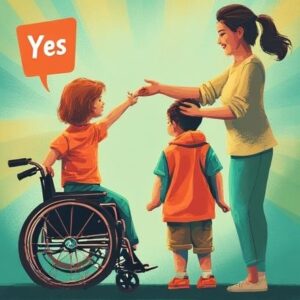
Hold out both hands: your left hand represents “yes,” and your right hand represents “no.”
Ask a simple question and observe.
If your child cannot point but moves their left leg, interpret that as a “yes.”
Reinforce their response with excitement—celebrate their success with a joyful reaction or a “happy dance.”
Dual Signals: Eyes and Movement
Sometimes, your child may use more than one signal. If they move their leg and also shift their gaze toward your left hand, they’ve just communicated in two distinct ways. This dual response is a breakthrough moment in communication in Cerebral Palsy. Acknowledge it, celebrate it, and continue building on it.
Encouragement and Consistency
Consistency is key. Use the same signals regularly and encourage your child every time they respond. Positive reinforcement helps them understand that their efforts are meaningful and effective.
Final Thoughts on Communication in Cerebral Palsy
Every child is unique, and so is their path to communication. By starting early, observing closely, and celebrating every small success, you’re laying the foundation for a lifetime of connection. Communication in Cerebral Palsy isn’t just about words—it’s about understanding, love, and the joy of being heard.