
The Basal Ganglia Connection: Bridging the Gap Between HIE, Stroke, and PANS/PANDAS
At the BRIGHT Foundation, our mission centers on advocacy and research for children who have suffered a brain injury involving cell death—such as HIE (Hypoxic-Ischemic Encephalopathy), Stroke, or complications from Prematurity. These are injuries where the initial damage is static, and the path forward relies on a neuroplasticity-based recovery strategy to retrain the brain.
While our primary work addresses these physical insults, we recognize a critical biological intersection with a condition known as PANS/PANDAS.
HIE & PANS – Different Triggers, One Neuroanatomical Target
The basal ganglia is the common denominator in both static brain injuries and autoimmune neuropsychiatric syndromes. While the initial triggers differ, the location of the neurological disruption is identical.
- Static Brain Injury (HIE, Stroke, Prematurity): Results from a discrete event—such as a lack of oxygen or a bleed—leading to immediate cellular loss. The injury is “set,” and the focus is on leveraging neuroplasticity to bypass damaged tissue.
- PANS/PANDAS (Inflammatory): Triggered by a common infection (Strep, Flu, or Lyme) that causes a “misguided” immune response. Instead of attacking the germ, the body’s antibodies target the basal ganglia, causing acute and severe neuroinflammation.
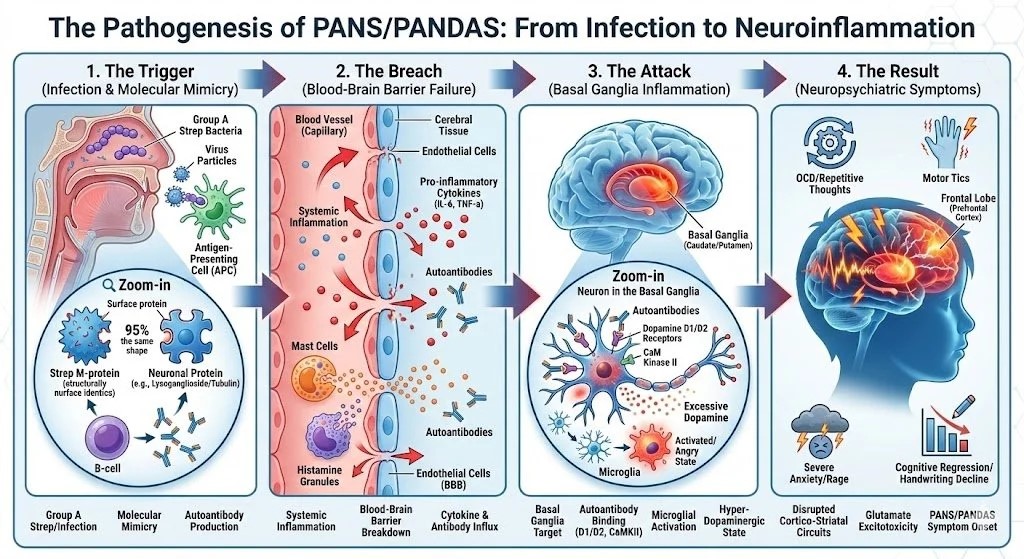
Image Credit 2026– Hyperchargehealth.com
The “Priming” Factor: The Role of Mild HIE
While there is no evidence that most PANS cases are caused by birth injuries, mild HIE can act as a “priming” factor. Research shows that neonatal hypoxic-ischemic events can cause a prolonged breakdown of the blood-brain barrier. This initial oxygen deprivation event—even one that does not show up on a standard MRI—can create a lingering vulnerability. This “primed” environment may lower the threshold for a future infection to trigger the autoimmune cascade seen in PANS.
The Case for Cooperation
The BRIGHT Foundation and PANDAS Network are natural allies because we are fighting for the same neural territory.
In the worst cases of PANS, the inflammatory “fire” in the basal ganglia is so severe or prolonged that it results in lasting motor regression or “entrenched” neurological pathways. At this stage, the child’s functional needs mirror those of an HIE or stroke survivor: they require high-intensity, plasticity-driven intervention to retrain the brain’s motor and cognitive loops.
Our cooperation focuses on Advocacy and Research Synergy:
- Advanced Diagnostics: Pushing for imaging and biomarkers that can differentiate between “scarred” tissue and “inflamed” tissue in the basal ganglia.
- Access to Therapy: Ensuring that children with PANS-related motor loss have the same access to neuroplastic movement therapies and advanced recovery research as those with HIE or other static brain injuries.
- Unified Legislative Voice: Joining forces to demand that insurance providers recognize basal ganglia injury as a basis for long-term treatment, regardless of whether the initial insult was an infection or an oxygen crisis.
Which Path is Your Child On?
Has your child suffered an HIE injury, Stroke, or Prematurity?
If you want to learn more about plasticity-based recovery and the latest in neuro-rehabilitative research:
Explore BRIGHT’s Research & Advocacy; Care (CpCare.org), Cure (CpCure.org), Community (CpVillage.org)
Are you seeing Immediate-Onset Symptoms?
If your child is experiencing sudden-onset symptoms after an infection (such as OCD, motor tics, “rage,” or a loss of fine motor skills), please visit our partners for immediate acute medical guidance:
Visit PANDAS Network