Tag Archives: cerebral palsy support

CVI - Little-Bear-Sees

Other Useful Foundations

Andrei Tallent sent BRIGHT this description of a foundation he is working with. The foundation is focused on Cortical Vision Impairment. Please take a moment to check out the website and learn more about this very common issue with children who have suffered a brain injury and cerebral palsy.

Cortical visual impairment (CVI) is the leading cause of visual impairment in developed countries today. In fact, it has been suggested that as many as 80% of those with cerebral palsy also have CVI. Though this is true, an appallingly few number of doctors and therapists know much about it. Many children who have CVI go undiagnosed or misdiagnosed as result. Parents are too often told there is nothing they can do to help their child learn to see. The reality is that CVI very often can and does improve, but only with focused and appropriate intervention.

We created our organization, Little Bear Sees, in 2011 in order to raise awareness about CVI among as many people as possible. Our first step was to create a website (www.LittleBearSees.org) which outlines exactly what CVI is and what you can do about it. In addition to our website , we have also created an iPad and iPhone app specifically for children with CVI (Tap-n-See Zoo) and have just released the first book about CVI written for parents by parents (Little Bear Sees: How Children with Cortical Visual Impairment Can Learn to See).

Every time we hear of a child with CVI who went undiagnosed for years, or meet a medical professional who knows nothing about CVI, we feel even more determined to raise awareness about this condition. In our experience, it is often you, the parents or caregivers, who fill the gap and become experts in CVI and advocates for your children. We hope that the information we provide will help you to do this.

Boy with cerebral palsy talking.

Cerebral Palsy Communication

Enhancing Communication in Cerebral Palsy: A Parent’s Guide to Early Connection

Effective communication in Cerebral Palsy is not just important—it’s essential. For children with Cerebral Palsy, developing a reliable method of communication can dramatically improve their ability to express needs, emotions, and choices. As a parent or caregiver, your role in nurturing this connection from an early age is powerful.

Why Communication in Cerebral Palsy Matters

Children with Cerebral Palsy often face physical challenges that affect speech, movement, and coordination. However, communication is still possible—and incredibly meaningful—when approached with patience, creativity, and consistency. Establishing communication in Cerebral Palsy early helps build trust, confidence, and emotional bonds.

Start with Eye Contact and Observation

Begin as early as possible. Look into your child’s eyes when you speak. Their eyes can be incredibly expressive. In fact, eye movement is often one of the most reliable forms of communication in Cerebral Palsy. When you talk to your child, pause and observe. Their gaze may shift, linger, or respond in subtle ways that signal understanding.

Using Movement as a Communication Tool

When working with your baby or young child, offer clear options and wait for a response. Watch closely for any movement—hands, fingers, legs, feet, or especially the eyes. These small gestures can become powerful tools for communication in Cerebral Palsy.

Example Technique:

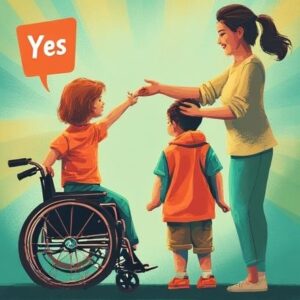
  • Hold out both hands: your left hand represents “yes,” and your right hand represents “no.”
  • Ask a simple question and observe.
  • If your child cannot point but moves their left leg, interpret that as a “yes.”
  • Reinforce their response with excitement—celebrate their success with a joyful reaction or a “happy dance.”
cerebral palsy comunication

Dual Signals: Eyes and Movement

Sometimes, your child may use more than one signal. If they move their leg and also shift their gaze toward your left hand, they’ve just communicated in two distinct ways. This dual response is a breakthrough moment in communication in Cerebral Palsy. Acknowledge it, celebrate it, and continue building on it.

Encouragement and Consistency

Consistency is key. Use the same signals regularly and encourage your child every time they respond. Positive reinforcement helps them understand that their efforts are meaningful and effective.

Final Thoughts on Communication in Cerebral Palsy

Every child is unique, and so is their path to communication. By starting early, observing closely, and celebrating every small success, you’re laying the foundation for a lifetime of connection. Communication in Cerebral Palsy isn’t just about words—it’s about understanding, love, and the joy of being heard.

By Kristi McConnell
photo credit: Bindaas Madhavi via photopin cc

Girl with Cerebral Palsy reading.

Picture Exchange Communication System (PECS)

Picture Exchange Communication System (PECS) was created in 1985 for young children with Autism. Over the years it is now being introduced to most children who are non verbal.

This is quite interesting how it is taught.

Phase I teaches the physical exchange of a picture; no discrimination is required.

Phase II teaches distance and persistence.

Phase III: Picture discrimination skills are introduced: first through pairings of preferred and non-preferred pictures.

Phase IV: Sentence structure is introduced: the simple request will now consist of the sentence starter “I want” + a picture of the desired item/activity placed on a Sentence Strip.

In Phase V, the PECS user is taught to expand on basic skills with the addition of attributes.

In Phase VI, individuals learn to make comments on interesting stimuli in the environment.

Here are a few videos of how PECS is used. Andy has completed all 6 phrases.

Andys PECS video part 1

Andy’s PECS video part 2

For more information regarding PECS…

http://www.autism-society.org/living-with-autism/treatment-options/pecs.pdf

Andy, Born Feb 4 2000 (Agpar Score 0,0,0,4 at 15 min, heartbeat @ 17 mins) 12 years old. HIE (Came home with G-Tube, Removed @ 14 mos.) Hypotonic, later dx’ed Mixed CP. Hydrocephalus has VP Shunt (revised 2000 & 2012) GMFM II almost Level I. Walks Independently but not well enough to play sports. Non-verbal. Uses ASL.

photo credit: thejbird via photopin cc