
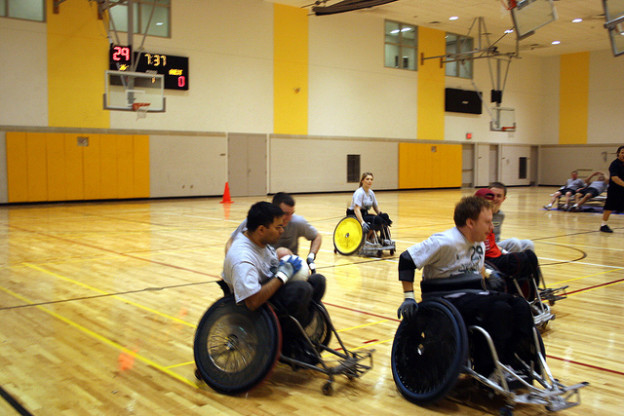

Quadriplegics playing Wheel Chair Rugby.
Spastic cerebral palsy is usually the result of an upper motor neuron lesion in the brain (often through injury or damage inflicted in the womb or during birth), though the motor cortex and corticospinal tract may also be affected. The lesion impairs the brain’s ability to send signals to the nerve receptors housed in the spine, which in turn limits the nerves’ ability to receive gamma amino butyric acid. Gamma amino butyric acid normally triggers the nerves to send messages to the muscles that cause them to work together; when one group of muscles contracts, another relaxes. The lack of this important organic compound in these damaged nerves instead causes them to send a signal to the connected muscles to tense up, or become hypertonic. In people with spastic quadriplegia, all of the nerve receptors that control the limbs are damaged, making all four limbs rigid and weak.
Spastic Quadriplegia Cerebral Palsy causes the limbs to be overly stiff while the neck and head are floppy. People with spastic quadriplegia usually have little-to-know voluntary control over their necks. Seizures are common in spastic quadriplegia, and spastic quadriplegia is the form of cerebral palsy most likely to affect intelligence. Many people with spastic quadriplegia have moderate to severe mental retardation.
However, because many people with spastic quadriplegia have a hard time communicating it can be difficult to assess the exact IQ level.
Spastic quadriplegia can lead to a number of complications, including limb and spine deformities such as scoliosis. Flexibility of the joints is diminished, which can lead to ankle and foot problems, making it even harder for people with spastic quadriplegia to walk. People with spastic quadriplegia also have difficult swallowing, and are at an increased risk for choking.
People with spastic quadriplegia may benefit from physical therapy to help strengthen their muscles and increase their range of motion. One of the biggest goals of treatment is increasing a person’s mobility.
References:
U.S. National Library of Medicine
BrainAndSpinalCord.Org
I found such an encouraging article about someone living with spastic quadriplegia. Please read it here: http://www.jw.org/en/publications/magazines/wp20150301/jairo-eyes/.